

What does "linked to" mean from a study?
Link, association, correlation - but not necessarily any proof of cause-and-effect

The following stories all appeared in one recent day on Google Health News.
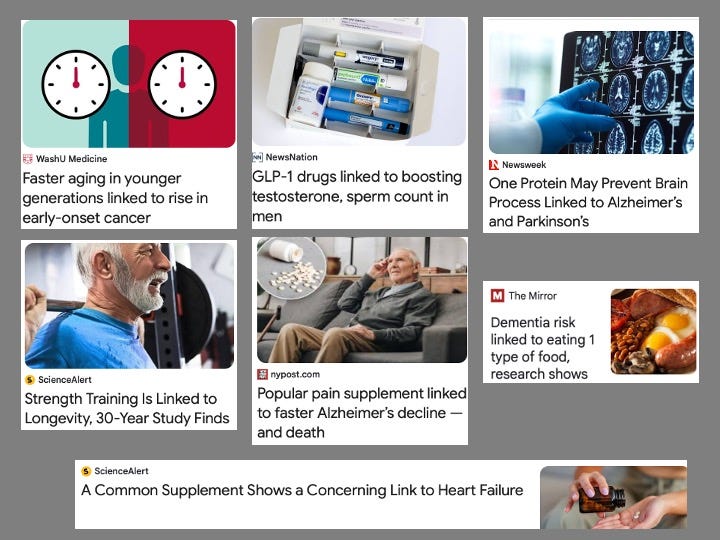
“Linked to” can carry a scary message. Or it can convey a hopeful message. There were examples of both types in the images above.
Maybe readers who see such links should be neither too scared nor too hopeful.
The most consistent take-home message whenever you see that X was linked to Y in a study is that the evidence probably isn’t strong enough yet to prove cause-and-effect. In other words, if you want that proof, you may want to put this story aside and check back later.
The following is going to be old news for some of my readers, but since my readership is quite diverse, I thought going into this in a little more depth would be worthwhile.
“Linked to” or “associated with” or “correlated with” all mean the same thing. A statistical association has been made between X and Y, but that may be due to a number of other confounding factors. Such studies are called observational studies because that’s what researchers do - they observe but they don’t intervene, don’t treat anyone or manipulate the environment. They observe what happens in real-life experiences.
Such evidence - in large numbers over time - can point to an overwhelming conclusion. That’s what took place with observational studies that showed the dangers of cigarette smoking. Two examples:
The British Doctors Study that began in 1951, following thousands of physicians, delivered early statistical evidence that smoking was linked to higher risk of lung cancer and other diseases.
The Hammond-Horn Study, started in 1951 by the American Cancer Society. This effort followed more than 180,000 men and further strengthened the association between cigarette smoking and premature death.
In this case, an observational study was the ethical approach because it would have been problematic to assign people to smoke for research purposes. The strength of the observational data was enough to lead to the 1964 Surgeon General’s report that concluded:
“Cigarette smoking is causally related to lung cancer in men; the magnitude of the effect of cigarette smoking far outweighs all other factors.”
But the other end of the spectrum is what I write about so often. It’s when small, short-term or weaker observational studies that may have not taken confounding factors into account are communicated - by researchers, those with special interests or by journalists - using causal language to describe the findings.
For 16 years, starting about 20 years ago, on my old HealthNewsReview.org website, we published a guide for journalists to help them use the correct language when writing about observational studies. It was one of the most-visited pages on our deep and content-dense site.

It began with this anecdote:
A health writer’s first attempt at expressing results from a new observational study read, “Frequent fish consumption was associated with a 50% reduction in the relative risk of dying from a heart attack.” Her editor’s reaction? Slash. Too wordy, too passive. The editor’s rewrite? “Women who ate fish five times a week cut their risk of dying later from a heart attack by half.” This edit seems fair enough – or is it? The change did streamline the message, but with a not-so-obvious, unintended cost to the meaning. Was the subjects’ fish consumption really responsible for their dying less frequently from heart attacks? The new wording suggests that’s the case, but the original study does not support a conclusion of cause and effect.
That guide has stood the test of time and can offer helpful reminders for researchers and journalists, as well as being a good teaching tool for patients and news followers.
Here are several examples I’ve written about wherein the wrong language about links/associations/correlations may have delivered the wrong message to readers.
I'll expand my comment from "Naps & death":
When an association is reported between two factors A and B, there are always four possibilities.
1) Perhaps it’s a fluke: about 2/3 of associations in the life sciences don’t appear again when the experiment is repeated with new data. Statistical flukes are very common. (https://en.wikipedia.org/wiki/Replication_crisis)
2) Perhaps A causes B. This is what the report implies and it could be the case, or …
3) perhaps B causes A instead. For example imminent death might cause frequent naps, or …
4) perhaps another factor C causes both A and B. For example, something (C) is going to kill you soon (B), but first it will sap your energy and make you nap a lot (A). Not napping won’t save you. It might do the opposite.
Whenever an association is reported, please consider all four possibilities.
How 'bout fish consumption is associated with piscine mortality? The studies that show correlation, association, and linkage may be the single best source of medical misinformation. Understandably, the public reads this stuff and presumes causality because it sounds very much like causality. I propose a study to examine if eating kale is associated with longevity, which I assume it is for reasons that have nothing to do with kale! Now, can we move on to surrogate markers...?